
Bolivia’s Agricultural Reset: From Three Decades of Restrictions to New Global Partnerships with Morocco
Bolivia is entering a strategic economic transition after decades of export restrictions and limited biotechnology adoption. As the country restores diplomatic relations with Morocco and expands international partnerships, new opportunities emerge for agricultural competitiveness, global trade integration, and investment across Africa and Latin America.
2/26/20263 min read
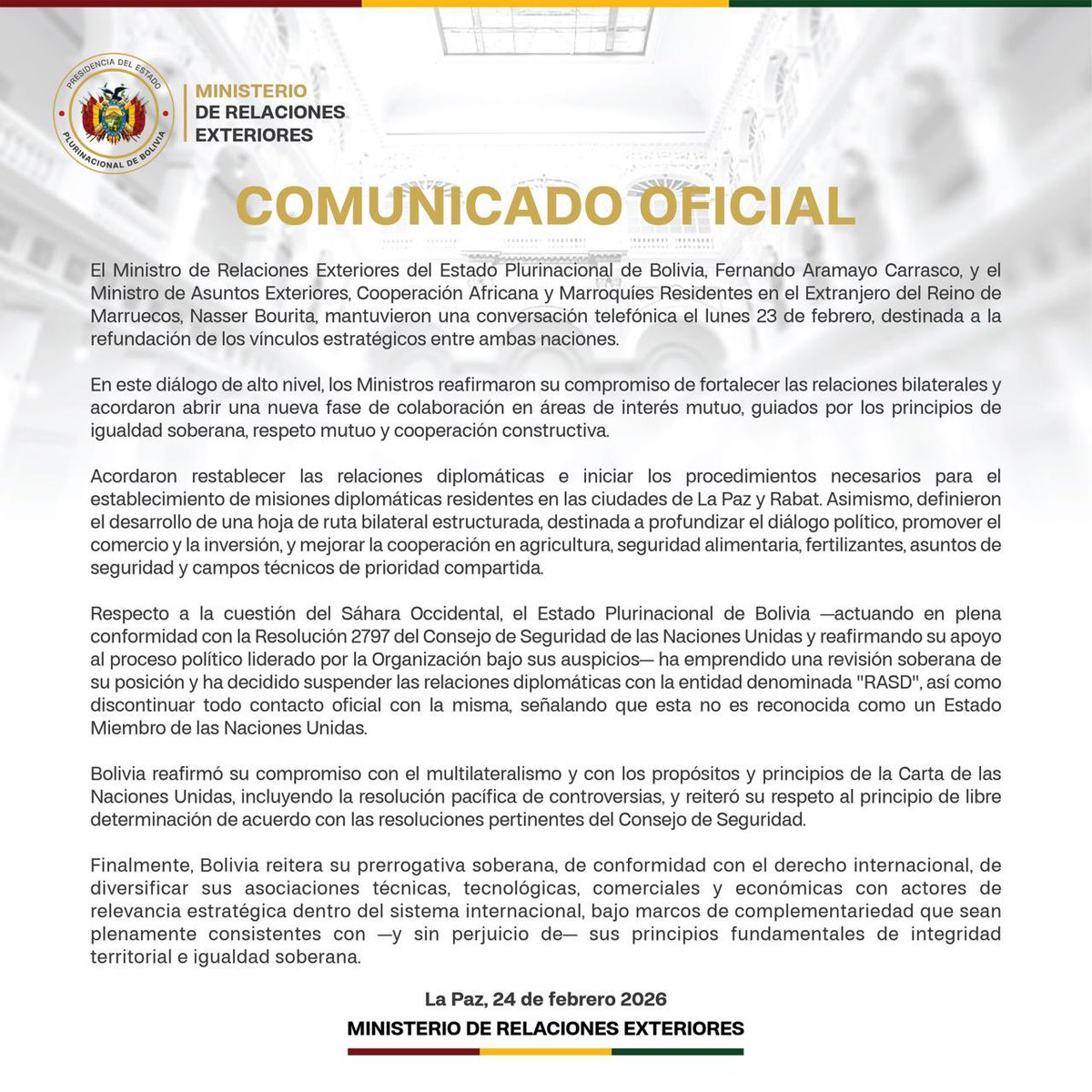
Between Quotas and Export Bans: Bolivia Stagnated for Three Decades in Competitiveness as New Opportunities Emerge with Morocco
February 24, 2026
For nearly three decades, Bolivia’s agro-industrial competitiveness has been constrained by export controls and restrictions on the use of agricultural biotechnology. While neighboring countries consolidated their global leadership in food production and exports, Bolivia maintained systems of quotas, export bans, and administrative authorizations that slowed the sector’s growth.
Today, within a new international context marked by the restoration of diplomatic relations with Morocco and a potential technological opening in agriculture, a new strategic window is emerging for the South American country to reposition itself in global food trade.
Three Decades of Restrictions on Agro-Exports
Since 2008, Bolivia has implemented policies aimed at ensuring domestic supply amid international price volatility. Key measures included:
temporary bans on exports of basic food products,
export quotas conditioned on domestic supply verification,
state-regulated price bands,
periodic suspensions of beef, soybean, and derivative exports.
These policies continued under successive administrations, including export restrictions imposed in 2022, 2024, and 2025 to contain food inflation.
Industry analysts argue that regulatory uncertainty reduced investment, limited production expansion, and weakened competitiveness compared with regional producers such as Brazil, Argentina, and Paraguay.
The Economic Cost of Limited Biotechnology Adoption
Export sector specialists believe Bolivia lost billions of dollars by failing to fully adopt genetically improved seeds, widely used globally since the mid-1990s.
The Bolivian Institute of Foreign Trade (IBCE) states that the country missed the opportunity to become a regional food powerhouse despite being part of South America’s so-called “food triangle,” an area with highly favorable soil and climate conditions.
Agricultural estimates suggest:
corn productivity could increase by up to 80% through biotechnology,
soybean yields could improve by approximately 30%,
agro-exports could have exceeded $10 billion annually.
Currently, Bolivia’s oilseed industry operates at roughly 60% of installed capacity, indicating significant growth potential without expanding agricultural land.
Gradual Opening and Regulatory Expectations
Producers expect new regulations aimed at removing bureaucratic barriers and facilitating exports.
Proposed reforms include:
elimination of individual export certificates,
gradual removal of price bands,
direct coordination between producers and industrial processors,
evaluation of new biotechnology events, including drought-tolerant HB4 soybeans.
Bolivia’s National Biosafety Committee is currently reviewing technical reports that could mark a structural shift in agricultural policy.
Morocco and Latin America: An Emerging Strategic Opportunity
The restoration of diplomatic relations between Bolivia and Morocco comes at a time when the North African country has strengthened its network of economic agreements across Latin America, positioning itself as a commercial bridge between Africa, Europe, and the Americas.
Morocco maintains cooperation agreements and economic dialogue mechanisms with several Latin American countries:
Chile: Free Trade Agreement in force since 2004.
Mexico: Free Trade Agreement signed in 2006 enabling triangular trade between Africa, the Americas, and Europe.
Brazil and Argentina: agricultural, scientific, and phytosanitary cooperation.
Andean countries: economic dialogue focused on fertilizers, agriculture, and technology transfer.
This network positions Morocco as a potential logistical and commercial gateway for Latin American exporters targeting African markets.
Africa: The New Destination for Latin American Agriculture
Africa’s demographic growth and rising food demand are turning the continent into one of the most promising markets for agricultural exports.
Bolivian producers are already identifying opportunities in:
West Africa, including Angola,
Southeast Asia,
emerging markets beyond the traditional China–Europe trade axis.
Morocco’s logistics infrastructure, international trade agreements, and strategic geographic position could facilitate market access.
Bolivia’s Diplomatic Repositioning (2025–2026)
Since late 2025, Bolivia has begun diversifying its international partnerships following years of relative diplomatic isolation.
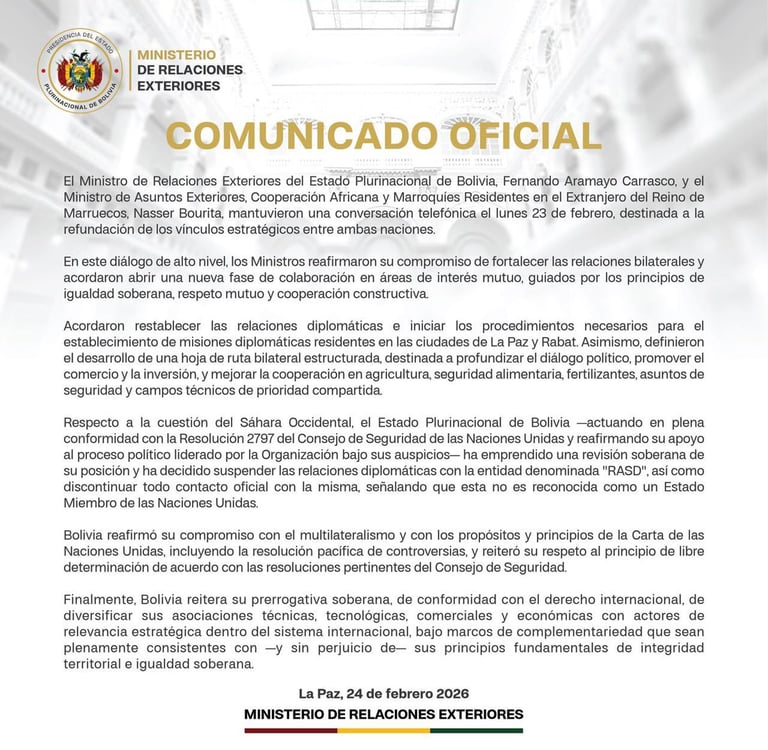
🇲🇦 Restoration of Relations with Morocco (2026)
suspension of relations with the entity known as RASD,
reestablishment of bilateral diplomatic ties,
future embassies in La Paz and Rabat,
economic, agricultural, and technological cooperation.
🇮🇱 Restoration of Relations with Israel (2025)
full diplomatic normalization,
expanded technological and economic cooperation,
promotion of tourism and bilateral trade.
🇺🇸 Resumption of Cooperation with the United States (2026)
renewed institutional cooperation,
anti-drug coordination,
gradual improvement of diplomatic relations after nearly two decades.
🇧🇷 🇺🇾 🇵🇦 Regional Engagement Initiatives
Bolivia is advancing cooperation with:
Brazil for regional economic coordination,
Uruguay for South American trade integration,
Panama for logistics and commercial cooperation.
The main objective is to improve international connectivity and access to global markets.
A Turning Point for Bolivia’s Competitiveness
The convergence of three factors could redefine Bolivia’s agro-industrial future:
gradual export liberalization,
adoption of agricultural biotechnology,
new international partnerships with bridge economies such as Morocco.
If these reforms materialize, Bolivia could regain regional competitiveness and significantly expand value-added exports, reintegrating into global food supply chains.
Contact
Business inquiries only. Privacy respected.
contact@marcelvian.com
© 2025. All rights reserved.