Dutch Greenhouse Agriculture: Innovation Driving Global Food Export Growth
Discover how Dutch greenhouse innovation drives global food exports and reshapes international agricultural markets through efficiency and sustainable production.
2/24/20263 min read
Dutch Greenhouse Agriculture: A Global Model for Efficient Food Production and Export Growth
How a Small Country Became a Global Agricultural Export Power
The Netherlands, one of the smallest countries in Europe, has become one of the world’s largest agricultural exporters, demonstrating how innovation, efficiency, and strategic market orientation can transform food production. Despite its limited land availability, the country has built a highly productive agricultural system centered on advanced greenhouse technology, sustainability, and strong collaboration between government, research institutions, and private companies.
For export-oriented businesses and international food markets, the Dutch model offers valuable insights into the future of agricultural production and global supply chains.
From Food Scarcity to Innovation Leadership
The foundations of Dutch agricultural success date back centuries, with early greenhouse experiments appearing in the 17th century. However, modern transformation accelerated after World War II, particularly following the “Hunger Winter” of 1944, which reshaped national priorities around food security.
The country adopted a clear long-term objective:
produce more food using less land, less water, and fewer resources.
This strategy led to continuous investment in agricultural research, technology adoption, and export-driven production systems.
High-Tech Greenhouses: The Core of Dutch Competitiveness
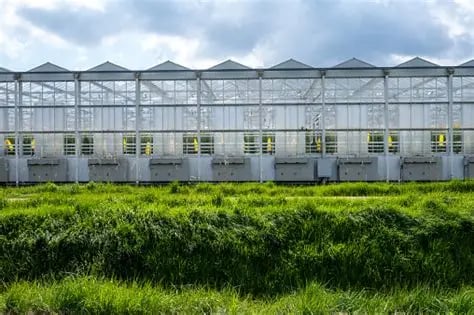
Today, Dutch greenhouse agriculture represents one of the most advanced farming systems in the world. If combined, the country’s greenhouses would cover an area comparable to Manhattan.
These facilities operate as controlled ecosystems where climate, humidity, light exposure, and CO₂ levels are digitally managed to optimize plant growth throughout the year.
Key technologies include:
Climate-controlled glass greenhouses
AI-driven environmental monitoring systems
LED lighting for year-round production
Precision irrigation and nutrient delivery
Automated data-driven crop management
This level of control allows Dutch producers to achieve exceptional productivity. Tomato yields, for example, increased sevenfold between 1950 and 2015.
Efficiency as a Competitive Export Advantage
The Dutch agricultural model is not only productive but highly resource-efficient — a crucial factor in global competitiveness.
While global averages require more than 200 liters of water to produce one kilogram of tomatoes, Dutch producers use as little as 4–9 liters thanks to closed-loop irrigation systems and water recycling technologies.
Energy efficiency also plays a major role, with increasing use of:
geothermal energy
solar power
heat recovery systems
circular agriculture practices
This efficiency reduces production costs while meeting increasingly strict European sustainability standards — a decisive advantage in international markets.
Innovation Ecosystem: Collaboration as a Growth Engine
A defining characteristic of Dutch agriculture is collaboration. Farmers, universities, technology companies, and government institutions work together within innovation clusters such as Seed Valley, often described as the “Silicon Valley of agriculture.”
This ecosystem accelerates innovation by:
sharing research and market data
testing new technologies rapidly
aligning production with export demand
developing improved seed genetics and production systems
The result is a continuous cycle of innovation directly linked to market needs.
New Agricultural Frontiers: Vertical and Floating Farming
The Netherlands is expanding agricultural innovation beyond traditional greenhouse systems.
Examples include:
Vertical farms, producing crops in multi-level indoor environments with precise control of water and nutrients.
Floating dairy farms, operating in urban port environments using renewable energy and recycled water.
Although still developing economically, these technologies demonstrate how food production can adapt to urbanization and land scarcity — trends expected to shape future global food markets.
Market Implications for Export and International Trade
From an export and market perspective, the Dutch agricultural model highlights several key trends shaping the future of global food trade:
1. Year-round supply stability
Controlled production reduces seasonal volatility, improving reliability for importers and distributors.
2. Quality standardization
Technology-driven cultivation ensures consistent product quality — a critical factor for European retail chains and international buyers.
3. Sustainability as market access
Environmental efficiency increasingly determines competitiveness in EU and global markets.
4. Knowledge as an export product
The Netherlands exports not only food but also agricultural expertise, greenhouse technology, and production systems worldwide.
Strategic Outlook for Global Food Markets
As global demand for food continues to grow — with projections suggesting that food production must double within the next decades — the Dutch approach provides a scalable model for sustainable intensification.
For exporters, distributors, and food supply chain operators, the key takeaway is clear:
future competitiveness will depend less on land size and more on technology, efficiency, and integrated supply chain management.
The Netherlands demonstrates that innovation-driven agriculture can overcome geographic limitations while strengthening export capacity and market resilience.
Conclusion
Dutch greenhouse agriculture represents a benchmark for modern food production. By combining technological innovation, sustainability, and collaborative ecosystems, the country has transformed itself into a global leader in agricultural exports.
For international food businesses, understanding this model offers valuable insights into emerging production trends, supply chain evolution, and future opportunities in global agricultural trade.
Contact
Business inquiries only. Privacy respected.
contact@marcelvian.com
© 2025. All rights reserved.